Posted by Scarlet Lotus St. Syr ADD COMMENTS

More thinking about my post Tired from the beginning of the month has lead me to this: if you don’t know, ask. Don’t ever be afraid to ask. While it’s not always enjoyable to me to explain how I identify to someone that doesn’t mean it’s not highly appreciated. I would much rather have an hour long conversation (or even five-minute) about my identities than have my gender, sexuality, spirituality, or anything else assumed. You know what they say about to assume…

For the most part I’m pretty open when asked a question directly. I don’t skirt around things and I will take a question at face-value and answer exactly what was posed. I might not offer up additional information, but I am not shy about answering questions when asked directly. While I don’t always enjoy talking about myself (I know, that may be hard to believe considering that’s most of what I do on this blog) that doesn’t mean that I would rather not be asked about something. If I can clarify something or explain something I am always happy to, as long as I have the time. I also try not to assume that the other person will know what I’m talking about.

This doesn’t mean I think they are stupid, but because I use terms in mostly academic ways and since I don’t know if they have read something I’m referencing in my identity or explanation I try not to make assumptions either way and opt to ask questions myself. “Have you heard of…”" “Have you read…?” etc. If not I try to explain as fully as possible, and even if so I often will still mention some of the basic ideas of what I am referencing to make sure we are on the same page. I do not assume anyone is on the same page as I am, but that doesn’t mean they are not as smart as me or any other nonsense like that. Knowledge on one specific subject has nothing to do with intelligence.

Specifically what I was referencing in Tired had to do with two types of people. People with whom I have had conversations regarding identity who then turn around and seem to ignore everything I have expressed about my identity regardless. Or people assuming they know my identity without asking or having a conversation about it. It is difficult for me in either of these situations to come out and say “I don’t identify that way.” I’m just not a confrontational person and it is often difficult for me to assert my identities. I realize not being able to do that is my problem, but I do think that making assumptions about someone else’s identity is never a good idea. Similarly, disregarding a conversation about an identity is also not a good idea.

It’s hard work to have identity conversations in general. I realize this. It’s difficult to ask someone a question about their identity, you can’t always know how that question will be reacted to. Just keep in mind that when you ask make sure to ask something regarding identity rather than pinning an identity to it already such as “how do you identify?” versus “are you a [insert identity here]?” You can use specific terms such as “What is your gender identity?” “What pronoun do you prefer?” “What is your sexual identity?” as well, though the slightly more open-ended “how do you identify?” may get you the widest variety of options.

Please, ask questions, ask clearly, ask for definitions of things if I or someone else uses a term in a way that is unfamiliar to you. Don’t be afraid to ask for clarification. It is far better to ask than to assume. While there may be the occasional person who is offended that you would ask or who doesn’t think it is any of your business that doesn’t mean everyone would be. That said, also think about what you are asking and of whom. Should you be asking complete strangers about what genitals they have (though this isn’t the same as gender identity discussed previously) or who they like to fuck? Maybe it is, depending on the context of wherever you are at the moment, but maybe it’s not. Be smart about it, segue into it, make sure it is appropriate, but don’t be afraid to ask if you sincerely want to know and don’t.

Similarly, if you identify with something out of the norm please don’t scare people away from asking questions, if they’re asking that’s at least a step above assuming your identity and questions are an excellent time to educate them and open their minds. Who knows what kind of chain reaction you might set off. If they ask in an inappropriate way then tell them so politely and educate them as to how to ask in a better manner next time. I can’t say I’m perfect at this, but I’m trying.

It is not easy on either side of the conversation. Sometimes I just wish I could fit into societal standards in one way or another and not have to worry about things like this, not have to figure my identities out in order for me to enjoy them and understand them. I get tired of explaining the same thing over and over to the same people, sometimes I’m tired of explaining in general even to new people who are genuinely interested, but that doesn’t mean I would rather not be asked. I’m glad to challenge normalized ideas and maybe, just maybe, open a mind or two.

Technorati Tags: , , , , , , , , , , , , , ,

Related posts

Categories: Gender, Queerness, Semantics
Posted by Scarlet Lotus St. Syr 4 COMMENTS

I’m just plain tired. I’m tired of having to explain how I identify, especially to the same people over and over again. I’m tired of people making assumptions about me rather than letting me make my own definitions and letting them know what my labels are. I’m tired of people thinking I’m straight because my partner is cismale or that I’m a lesbian because I prefer female-bodied people. I try not to let it bother me when someone mislables me, but it hurts every time.

It’s difficult to inhabit middle identities while living in a binary world. There are many days when I wish I could just feel “one or the other” instead of seeing all the wonderful options out in front of me and wanting to have one of every flavor. Call me indecisive if you want, but when I can see the beauty and joy I could get from every option I can’t just pick one, it’s not in my nature.

I’m not straight or a lesbian, I’m queer. Bisexual, maybe, though I don’t like the binary aspect it implies and prefer other terms. Queer is the best description I have. Really I tend to be attracted to other queer people regardless of their gender and specifically because of their intelligence and/or personality. I’ve used intellisexual for quite some time, sapiosexual also fits which is a slightly more common term. I am attracted to people’s brains more than anything else, and usually those brains have to be queer in some way shape or form.

Similarly I do not identify with the term woman. It’s simply not a word that I identify with nor is it a way I see myself or desire for others to see me. While I may often wear feminine drag that does not make me a woman (or any spelling variation thereof). The same goes for girl. My gender identity is genderqueer regardless of the gender expressed within my gender presentation01. My gender presentation is always drag.

While I do associate with the term femme I embrace it as part of my gender presentation. I embrace the gothy glittery drag queen femmeininity that is all mine most days, though not all days. Femme is my presentation more than anything, but there are also days when I wear my too-small-sports-bra-slash-binder and present as fagette. I do think that my “fagette” presentation confuses some people, however, because it still some femininity in it, dressing in boy drag is not a spectrum-banging event for me. I am realizing more and more, though, just how much femme and fagette go hand in hand for me. There are no days when I am femme that I am not a fagette, and no days when I am not genderqueer.

Recently I’ve begun using gender neutral pronouns when I am able and it makes my entire being sing. A friend of mine referred to me using ze and hir without my first requesting it and it nearly brought me to completely unexpected tears to be seen in a way that aligned with my own gender. I catch myself internally wincing when words and identities other than my own are thrown at me in conversation, but often I don’t have the energy or desire to confront the misconception of me in the eyes of others, which just ends up perpetuating it.

I’m trying to get to the point where I am not looking for the validation of others for any of my identities, but it’s difficult not to want that. I want to be seen rather than assumed away as something else. I realize that I am responsible for making myself a whole person in the eyes of others and do not put the responsibility of figuring me out completely on other people but I’m so damn tired of having to correct people. It seems like a petty difference to ask someone to not refer to me using certain language, and yet it cuts me deep whenever it happens. I just haven’t gotten to the point where I am comfortable asserting my gender identity, perhaps because it is such a fluid work-in-progress.

  1. I’m using gender identity and gender presentation to mean two different things. Someone’s gender identity has to do with the internal gender feelings the person has, whereas their gender presentation is the outward gender they show to the world. These do not always go hand-in-hand. []

Technorati Tags: , , , , , , , , , , , , , ,

Related posts

Posted by Scarlet Lotus St. Syr 1 COMMENT

Onyx and I have settled in to a remarkably comfortable D/s dynamic. We have talked extensively about it, but the difference this time is that it just clicks, for lack of a better term. All the background issues that were making so much noise the last time we were trying these power roles have been resolved, thanks in large part to the many things we learned through the trial of the triad. I find myself enjoying to do things for him, and he is now more able to push and guide me than he was before. It is, in a word, wonderful.

I have noticed that I am hesitant to share this power dynamic with others, even on here to an extent. I believe this is in part due to it still, in some ways, being so new and foreign but mostly it is because it is still private and vulnerable. Despite the abundance with which I share my private feelings and thoughts on this blog (less so now than I have before, but I’m working on writing more when I don’t have writer’s block) I have an extremely difficult time sharing personal things with others, especially in person and especially those I don’t know very well. Hell, I even have trouble expressing things to Onyx sometimes which I would have no issue writing to him.

The last couple of weekends while going out with amazing people I’ve noticed myself being slightly more comfortable but still not all that comfortable with expressing my submissiveness, and that was with fellow kinky perverted people who have read my blog including stories of me being slapped and dominated and fucked. I don’t mean showing my submissvieness to them, but just talking about it.

I see others so secure in their submission and happy to proclaim to the world that they are submissive and I find myself having trouble with that. Perhaps it is because I am a switch. I can’t fully embrace my role as submissive because, although I feel submissive to Onyx, I do not feel wholly like a submissive. I cannot throw myself into submission with complete abandon because I am also a Top. Or, that is the roadblock I come to in my mind.

Although I don’t consciously think this is true, there is a part of me that thinks embracing submission fully would mean giving up the parts of myself that are not submissive. Call it internalized binary programming that says I have to be one or the other but never both. The way some people say someone can’t feel Dominant and submissive at the same time, but I highly disagree, I say I am always both and it is the people I am with and situations I am in that bring each out in me.

However, I don’t have any hesitations about expressing my dominant side. I think in part this is because it is less vulnerable, less private, in a way. I am more comfortable with it, but also because it seems to be less normative. It’s more “okay” to express because it somehow shakes up the expectations.

I feel the same way with sexuality and gender, I’m far more comfortable expressing my desires when they have to do with cis-females or trans-people than when they have to do with cis-males. Essentially, I’m far more comfortable expressing my queer sexuality than what would be seen as a hetero-sexuality, as if expressing desire for cis-males somehow makes me less queer. Of course, in some minds it does. In some minds it would completely invalidate any other expression of queerness.

Similarly with gender I have been desiring lately to express my masculine side, the personae (yes, plural) I designate as Quyn or Sebastian sometimes. I used to dress more masculine and drifted to the feminine and now I’m working on finding the way to be both or neither, to dress as I please. While I’m more comfortable expressing my femme drag queen gender identity I think because that, in some ways, is the one that is less normative, despite being assigned female at birth, but that’s a whole other post.

Perhaps in the same vein expressing submissive desires could somehow invalidate any expression of dominance. I’m not saying this is the case, but I do think that Aristotelian logic is so ingrained in our culture that it is difficult to work against. If we express ourselves as being on one side of a cultural binary we are not only saying what we are but we are saying what we are not. By this logic when I say I am submissive I’m also saying I’m not dominant. It works for everything, really: power, sexuality, gender, etc. All the identities I hold middle ground on, certainly, and others as well.

I’ve talked about this many times before, I know, and read about the phenomenon. It’s not new, but it is significant. The point I’m trying to make here, though, is that I’m more comfortable expressing one aspect but not another on these supposed binaries (and I should point out that I do not see power dynamics or sexualities as part of a binary system, but they are largely seen culturally to be so which makes operating outside of them difficult and that is why I am referring to them as binaries), and my comfortability seems to be backwards. I am comfortable expressing the non-normative desires, those outside what is culturally expected, when it’s usually (or so I think) the opposite.

I want to be just as comfortable expressing and embracing all of my identities, and the first step just like with anything is acknowledgement. I have internalized binary and aristotelian logic programming. I have internalized power dynamic programming. I can actively work on acknowledging this programming and work to move beyond it, and that’s what I’m trying to do. Instead of thinking of these socially contrary ideas in terms of conflict and feeling dissonance over them I want to get to a point of doublethink, where I am comfortable with embracing these identities that seem to be contradictory and am, further, comfortable in my own skin. That’s what it’s all about in the end, anyway.

Technorati Tags: , , , , , , , , , , , , , , , , , , ,

Related posts

Posted by Scarlet Lotus St. Syr 35 COMMENTS

At some point before I’ve talked about relationship needs, that is the needs of the relationship, but in the last few months something that has been extremely important for me to realize has been a different sort of relationship need, that is, a lack of need.

When I was younger a relationship or, more accurately, the absence of and desire for a relationship was always the focal point of my life, with other things often working to fill the void I felt without a partner. I think part of the reason why I left theatre life is because I was so focused on the need to be in a relationship, the need for a partner, and I thought theatre would distract from that. The reason I have recently been able to come back to it is because of this new lack of a need.

The word “need” is thrown about so much even though so often it is impossible to accurately separate needs from wants when in the moment, one must step outside and analyze and discern in order to figure out what is really necessary and what is a passing fancy, and even that is difficult without hindseight. Luckily life is much like the philosopher Jagger sang01, and often these things work out on their own. Needs aren’t bad things by any means, so long as we can distinguish between need and want.

So often are we told that in order to be a complete and true person we must be in a couple, we are only part of a whole, and when we are told something over and over again it becomes like a need. We do not need others to fulfill or complete ourselves, though we often feel like we do because we are told that we do for various reasons. We are told we are incomplete without the perfect partner, not to mention marketing strategies which tell us we are not complete without some product or another, but that is a whole other post. The point is we need to be able to be happy and complete without external influences.

This isn’t to say that we don’t need relationships. After all, humans are social creatures, as the cliché tells us, and I’ve studied enough psychology and sociology to know that is basically true02. While love is part of Maslow’s hierarchy of needs relationships in general aren’t the same as the idealized spend-all-of-your-time-together can’t-think-of-anyone-but-each-other completely emotionally dependent romantic relationships perpetuated by society. We grow up thinking that is what we need, to find someone to fill the void within ourselves, before realizing that no one can really fill that but ourselves.

Need indicates more than a desire. Saying that I need something is the same as saying that there is some fundamental part of me that requires something in order to survive, be complete, or be happy. I do need friends and relationships, but that doesn’t mean I need any one specific person. If that was true than no one would ever maintain friendships outside of romantic relationships.

Distinguishing the difference between the idealized relationship and a healthy independent relationship is something the triad taught me. While I knew in my head that it was best to have lives and friends and interests outside of the relationship I always had a difficult time engaging in anything like that aside from school. Once I graduated I lost my outside focus and my relationship with Onyx was strained ever since. He was also supporting me financially, he was basically providing me with the first three levels of my hierarchy of needs and neither of us was completely comfortable with that.

Spending time away from him really has done wonders for our relationship, for both of us. I’ve gotten to the point of embracing my autonomy and independence, enjoying time alone in a new way, which was truly necessary after the triad, which truly was a spend-all-of-your-time-together dependent romantic relationship. In addition to everything else I actually think rediscovering this independence has actually been a major catalyst for the rediscovery of my desire to be submissive for long periods of time rather than for short bursts during play. Now that I am not dependent on him my choice to be submissive is that much stronger. But I digress, that also is another post.

“I need you” now leaves me with a bad taste in my mouth. I don’t want to be needed or to need anyone else, it puts too much pressure on the relationship. I would rather everyone involved was coming to the relationship from a place of want and desire, a place where the relationship is fun, voluntary, and exciting rather than necessary or required. Thus I am officially striking the phrase “I need you” or any derivative thereof from my romantic repertoire. I choose instead to employ phrases such as “I want you” or “I crave you” which are equally as powerful but are less dependent.

edit

Brought to my attention by the wonderful Kristi, Amanda Palmer’s cover of “I Want You, But I Don’t Need You” is fabulously in the exact same vein as my post above, and therefore needed to be embedded and shared. Not to mention it’s Amanda Palmer which automatically makes it that much more awesome.

  1. Referencing both the pilot episode of House and The Rolling Stones, of course. []
  2. I do have a degree in Psychology, which basically just allows me to go “hmm” when presented with any personal information about a person. []

Technorati Tags: , , , , , , , , , , , , , , ,

Related posts

Posted by Scarlet Lotus St. Syr ADD COMMENTS

adipositivity268Image from The Adipositivity Project

This is the tenth of many posts with answers to my Size & Sexuality Study questions within them. The responses have not been edited in any way. I hope you find them as interesting and informative as I have. I have gotten a huge number of responses already and I still want more! If you would like to answer these questions you can find more information on The Size & Sexuality Study here including links to the other responses.

Lori is a 38 year old female who is “straight, with long held and so far unfulfilled bi curiosity (straight with a slight curve, perhaps?)” and married.

What size is your body?
Last weight put me around 300, but the number means little to me. Carry my weight in my hips, thighs and ass, mostly. Although, I have never considered myself to seem out of proportion or necessarily pear shaped.

How comfortable are you with your body both in general and your body size specifically?
I am quite comfortable within myself. I have days where I want to stay in the bed and do nothing but hide from the world, but I have never considered those ‘fat’ days. I wish it were easier to find stylish clothes, but have never blamed this on my body as much as the fashion industry who doesn’t recognize me, or on a society which refuses to accept that I have as much right to great clothes in a size 30 as someone who is a 0. My body size isn’t something I think about a whole lot. I like my body size, and feel very comfortable in my own skin. I’m lucky that way, as many of my girlfriends – thin or fat – don’t seem to share that.

How has your relation with and attitude toward your body and the size of your body changed over time?
I was very lucky to have had influences in my life that propelled me toward healthy self-esteem. I certainly went through a phase of self hatred, which I commonly refer to as high school. Post high school though, I realized that I could really care less how other people judged me. I came to the conclusion that I had no reason not to love myself and haven’t really looked back on that. I have had successful relationships, both long term and…shall we say rather shorter term? I never felt that my size should be an issue, and I’ve tried not to make it one in my head, either. I have gained weight over the years, but in those years my attitude toward my body has actually become more accepting, rather than less as might be expected.

How important is sexuality to your life?
Extremely important. I love my sexuality, and I love expressing it. As much as possible.

How has your relation with and attitude toward your sexuality changed over time?
I started having sex when I was 18. Not good sex. Just sex. It filled a need, but barely. I was having sex back then, but I don’t think I can say that I saw myself as a particularly sexual being. Over the years, I have realized that I am extremely sexual, and with this epiphany have also opened myself up to new experiences. In the past I think there was always a part of me that I declined to face; the part that said that I wasn’t allowed to be exactly who I was. It is possible that my weight played into this, but I’m not sure that is where the roots were truly planted. I believe that it is more likely that I recognized in myself needs and behaviours that seemed to clash with what I thought to be ‘normal’ for me. I had a far harder time accepting my sexuality than I ever did my weight. I have come to realize that the state of normal exists only in what we are contented with. It’s really only been in the last few years that I have not only found what satisfies me, but also have come to embrace it as another facet of myself that I am perfectly content with. I realize that there are any number of people out there who will equate my weight with some form of self-protection to “keep me from facing” my sexuality. I understand that thinking. However, in my case, it was at my heaviest that I truly realized how sensual and sexual a being I am.

How comfortable are you with expressing yourself and your body sexually?
Very comfortable. No wilting flower am I. I have no trouble expressing myself and my sexuality.

How comfortable is society with the idea of viewing your body as sexual?
Not comfortable at all. Society is not comfortable in accepting my body, so how is it possible for it to accept my body as sexual? There are a lot of facets of society that seem to hold very unshakable opinions as to what fat women are supposed to be. And a confident, sexy, sexual woman is not often equated with a fat one.

Through answering these questions and/or thinking about your relation to your body and your sexuality, have you noticed any links or similarities between the two? If so, what?
I have noticed a link, actually. But it’s probably not one that would come to the mind of someone looking at me from the outside. As my sexuality has blossomed, I have come to love my body even more. It’s a very simple equation. How could that which gives me so much pleasure, and is capable of providing others so much pleasure, be anything but a gift? I cherish my body, because it is capable of so much. The fact that my body isn’t a size two doesn’t equal sexless, or loveless. The more I’ve let my body experience, the more I stand in wonder at what a marvelous thing it is.

Technorati Tags: , , , , , ,

Related posts

Posted by Scarlet Lotus St. Syr ADD COMMENTS

If there were a Venn-diagram for non-monogamous relationships it would probably start as a big circle for non-monogamy. Inside that would be polyamory and inside that would be polyfidelity. Each of these circles would be blurry or maybe dotted lines instead of hard ones. Each circle would overlap with multiple other relationship configurations and various other types of relationship orientations and… well, maybe a Venn-diagram isn’t the most helpful illustration.

When defining a term that has to do with relationships or personal identities in any manner there is always some level of fluidity and openness to take into account. You may know this already, but I’m starting with the basics.

In the book Opening Up Tristan Taormino defines polyfidelity as “a multipartner group of three or more people who have made a commitment to each other to be in a primary relationship.” This can be different or exactly the same as polyamory simply depending on the identification of those within the group. There are no hard and fast lines here, and the terms really just depend on what the people within the relationship are most comfortable with.

Despite the “fidelity” part of the term, which makes most people think of having closed sexual conduct polyfidelity does not always exclude other relationships outside of the polyfidelitous group. Fidelity essentially means “faithful” and doesn’t necessarily have anything to do with sexual faithfulness (though it can). Taormino describes two types of polyfidelitous groups: closed and open, meaning closed or open to new relationships outside of the primary. Not all members of a polyfidelitous group have to be sexually involved, either.

While I dislike the terms “primary” and “secondary” or so on and I think maybe a better way to describe it is that everyone in a polyfidelitous relationship is committed to everyone else. Even if there isn’t a sexual or romantic relationship between the individuals there is always an emotional one and a commitment to being with the other in some way shape or form.

As I mentioned, this could look identical to polyamory or it could look completely different, it just depends on how the individuals want to identify.

So, why am I writing all this about polyfidelity? I will probably be using it in the future and now I can reference this post whenever I mention it.

I posted a while ago about our transition from mono to poly to triad and Not long after that I brought this difference up to Marla and Onyx and we all agreed that the definition for polyfidelitous fit our relationship.

Generally speaking the term triad is used to describe a polyfidelitous relationship between three people, so we had already kind of figured that out but at the same time I’m a sucker for semantics and finding new terms and labels to describe myself so that I can add them on to the long list of labels I already embrace to make such a long string of labels I eventually essentially become label-less again, though that’s another post.

Another term Taormino mentions in Opening Up is “trilationship” which is fairly self-explanatory I think. I pronounce it similar to tree-lationship so it sounds similar to relationship only different–also because pronouncing it try-lationship is kind of awkward. This is another term I will be using in the future.

Technorati Tags: , , , , , , , , , , , ,

Related posts

Posted by Scarlet Lotus St. Syr ADD COMMENTS

I’ve been trying more vigorously to finish Opening Up by Tristan Taormino which, if you don’t know, is all about non-monogamy. I started it months ago but have yet to finish it because I keep picking up other books in the meantime (mostly ones I have to review).

In Opening Up defining a relationship is emphasized, but not in order to box in or pin down a relationship (because the ability to revise or change the relationship at any time is also emphasized) but in order to make sure that everyone within the relationship is in agreement and happy with where it is and how it’s progressing and feeling and working.

Basically, communication is key, and though that’s true in every relationship it can be exponentially trickier in non-monogamous relationships to make sure that everyone is happy with everything that’s going on.

Part of successful communication can be coming to agreement on terms and labels used for certain interactions and activities. I like labels as long as they are recognized as flexible and subject to change. While terms don’t dictate a relationship one can use terms to define a relationship as close to accurately as possible.

Sometimes defining a relationship is a useful tool to use to check in with everyone in that relationship and make sure everyone is on the same wavelength. I’m over-explaining a bit, I realize, but I have a point to make, promise.

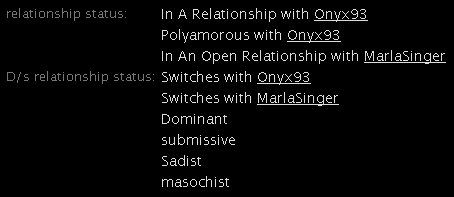
The reason I bring this up is because this morning I changed my FetLife profile information from reading “Polyamorous with Onyx93″ and “It’s Complicated with MarlaSinger” in the “relationship status” portion and “Switches with Onyx93″ and nothing defined with MarlaSinger in the “D/s relationship status” portion to what is below.

fetlifestatus

Little changes on social networking sites like this aren’t really a big deal in some ways, but they definitely do mark a change in the way I’ve been thinking about our relationship that I’m able to actually put that we’re in a relationship quite solidly. I do feel like we’re more solidly in relationship territory rather than the “getting to know you” or “friends who are interested in each other” territory which is where we’ve been for a while, even without the presence of gettin’ down and dirty.

I’m not really sure what the distinction between “In a Relationship and Polyamorous with Onyx93″ and “In an Open Relationship with MarlaSinger” really is but I think it has something to do with the stages each of those relationships are in.

Onyx and I are very much set in our relationship, though that’s not to say we’re stagnant or unsatisfying. We’ve been together for about four years and have been living together for over two and a half of that. While we still have our bumps and explorations for the most part we’re really very solid in where our relationship is, which is also why we’re able to start branching out into other relationships. I am in a relationship with him and we are also polyamorous, that’s just how I see it.

Maybe part of the difference too is because Marla and I are long-distance and still exploring the beginning stages of our relationship. To me, indicating that we are in an open relationship also indicates less permanence in our relationship as opposed to being polyamorous in a relationship. That’s not to say our relationship isn’t permanent but it’s not as set as my relationship with Onyx because we are still discovering nuances and facets of each other that are new and unexpected and discovering the ways in which we fit together.

These are just the distinctions my brain is making between the two terms, of course, and I wouldn’t force these definitions on anyone else, they’re just what work for me.

We are still slowly progressing in our own long-distance way, which is really enjoyable and wonderful but also frustrating because, well, it’s long distance.

We’re constantly getting more sexual with each other, getting to that next step, moving beyond the “abstractly sexual” talk of toys and such to much more personal talk of desires and where we think we fit together. It’s fantastic, and I find myself fantasizing about being with her (my latest Microfantasy Monday post was in many ways inspired by her) but I’m also getting anxious for the next sexual step.

Neither of us seem terribly desirous of engaging in sexual activities online or on the phone, preferring to wait until we meet to explore the physical sexuality with each other, but the desire and the drive to do so is slowly becoming more and more apparent. This is definitely a good thing, but also a frustrating thing.

I’m confident that it will unfold in a way that works, though, and really have hardly any doubts or worries about the relationship and how it is progressing. It almost seems too easy sometimes, too perfect for my overlyanalytical brain to handle, but it felt like this with Onyx as well and look how that turned out…

Also, Marla wrote a delightful, adorable, and fantastic post on her blog that you should read in the same style as my five things that make me constantly and undeniably happy.

Technorati Tags: , , , , , , , , , , , , ,

Related posts

Posted by Scarlet Lotus St. Syr ADD COMMENTS

The more I look back over the comments on this post, you know the one, the one I wrote about already, the more I think I reacted poorly. And, well, I’m sure I did, as all my reactions were emotional reactions, either a “ouch I’m hurt” reaction or a “I offended you, I’m bad, I’m sorry” reaction. Neither of which made me react in a way that was at all constructive.

Honestly I’m not sure how to be constructive in a situation like that. The people involved were obviously looking for something to be offended about rather than trying to understand my experiences. Maybe I should have ignored it all together, but it really really hurt me, so much so that I felt I had to respond in some way. If only I could get them to understand what I actually meant… but rationally I knew that nothing I said would change their minds, and so I went for the other route: apologize until they realize it was unintentional. Well, that didn’t do me any good either.

Something that helped me yesterday after this first started was a piece by Madeline H. Wyndzen a transsexual psychologist titled Why are Trassexuals so mean to each other? which applies not because I’m a transsexual (I think I’ve made that clear) but because the reaction that she’s talking about is actually pretty universal, and I think transsexual people react this way to someone who is outside gender lines as well.

This is my first interaction that I can think of where a post of mine offended someone enough for them to personally attack me. I’ve gotten personal attacks before, but never on my blog, never on the subject of my gender, and never due to me being offensive to someone else. I tend to be hypersensitive toward others, which is why something like this is such a blow to me when it happens because I tend to err on the side of caution. I’ve made mistakes before, sure, and I’ve misspoken, but never to the point of being so blatantly attacked.

Looking back, one big thing I would do differently is I would stand my ground more firmly. I wasn’t appropriating trans experience by using the same language. I wasn’t even close to that, they chose to interpret my words that way. By saying I have cissexual privilege somehow that makes it okay for them to ridicule me but not okay for me to use similar language or identify with a quote from someone who was not even considering transitioning when he wrote it? Would my gender issues be more valid if I transitioned? Probably in their eyes.

What does claiming to have a more difficult time being marginalized compared to other marginalized groups get us? Nothing. No, wait, it gets us squabbling within groups that should be supportive rather than the support that the people within the groups actually need.

I do find it ironic that the first attacking comment made to me focused on telling me that I failed at my gender. What trans person doesn’t hear that at some point in their life? The gender failure was partially intentional as every gender fails, all gender is drag, and no gender is perfect, which is something I enjoy playing up when possible.

I also find it ironic that I was told that the gender I feel on the inside isn’t real by a trans person. Let me say that again: a trans person told me that the gender I feel on the inside is not real. Um… does anyone else see the obvious flaw here?

This brings me back to Why are Trassexuals so mean to each other? by Madeline H. Wyndzen. Her big point is that it’s a defense mechanism, one quote which is particularly apt is: “a lot of us feel this need to put others down in order to feel better about ourselves. And many of us are hypersensitive to ‘criticism’ so we can often misread an innocuous remark as though it was saying something invalidating about us personally.” It’s easy to read something offensive into something when you’re looking for it to be offensive or if you are hypersensitive to anything that might possibly be offensive if taken the wrong way.

Another thing she said also rang true for this situation: “if anybody really bothered to challenge if I’m a “real girl” or a “real transsexual”, I would just go “whatever” and think they really need to get a grip and not waste so much of their time deciding what I ‘really’ am.” Basically, why do they even care that I’m using the same language? Why does it matter to them what I call myself or don’t call myself? Shouldn’t that only matter to me?

As Elizabeth pointed out in the comments of my last post, this issue wasn’t actually a misunderstanding and that probably the best thing to have done in the situation was not to engage them, especially since I knew it wouldn’t do any good.

Gabe has helped me come to the ideas in this post as well, mostly to make me realize how bad it was of me to give in like I did, essentially placating anything that they said to appease them rather than standing my ground. He was nice about it, probably nicer than he should have been.

I have a tendency to roll over and give someone anything they want if they are telling me I offended them. I will do just about anything to try to make them not hate me, as that is something that hurts me inside and out, it’s not rational, but it’s the way I work. Like I said above, I reacted in a “I offended you, I’m bad, I’m sorry” way which was not at all constructive.

Overall if I had to do it again there would be many differences, at least in theory. I’m not sure, should something like this happen again (and, let’s face it, it’s the internet and a touchy subject so it’s bound to happen again), I’m not sure I could actually disregard my automatic “coddle and appease until they don’t hate me” reaction, but maybe I’ll remember this situation and at very least wait to respond until I have something better to say, or just not respond at all.

*quote from House Season 4 Episode 11 “Frozen.” Used because I tend to be hypersensitive to the feelings of others, and often nice beyond the realm of necessity.

Technorati Tags: , , , , , ,

Related posts

Categories: Gender, Introspection
Posted by Scarlet Lotus St. Syr ADD COMMENTS

My heart hurts a little. I woke up yesterday to an attack on my gender, which if you follow me on twitter you’ve probably already heard about.

I wrote a post not too long ago on The Femme’s Guide about my newfound femme fagette identity, my multigendered femme identity and I was hoping for a while that more people would comment on it, so I suppose this is the one of those “be careful what you wish for” moments.

I woke up to this comment:

Hi.

You are a cissexual person appropriating the expriences of trans women and other MtF-side trans people.

Wearing a feather boa and badly-applied lipstick that is the wrong color for you with your t-shirt and half-assed fauxhawk does not make you a drag queen and isn’t even particularly femme.

You are not a starfish, snowflake, or magical twinkling unicorn, and your personal identity is not a form of activism.

Pretty much a direct personal attack on my person, my gender, and my appearance. I replied well, or so I thought, but apparently I was being condescending and though I was trying not to be defensive it’s difficult not to be defensive when someone is out and out attacking you.

The comments went on, but one person stopped commenting and another took over. This second commenter was much more reasonable and constructive, she didn’t attack just told me to pay attention, basically, which I am grateful for. You can read all the comments here, many of which are insightful and thoughtful not just personal attacks.

The big issue that was offensive was they thought I was trying to appropriate trans experiences, which I wasn’t. Here is part of my latest comment:

When I talk about gender I’m not talking about anything “biological.” Never in the post did I talk about my sex, only my gender, and I get attacked with “you’re cissexual trying to be a trans woman” which is not at all what I’m saying. Am I cissexual? Very probably. I’ve never had a real affinity toward my sex, I don’t “feel” female (whatever that means) but I don’t feel male either so I’ve thought about reassignment surgery but, like the quote above, I’ve “decided that would not resolve my gender conflicts.” (Note: the quote I am referring to is the same one in this post) Part of the reason I love that quote. As Riki Wilchins said, you can say “I feel like a woman trapped in a man’s body” (or in my case, woman’s) and get results, but if you say “I feel like a herm trapped in a man’s body” people don’t understand and would think you’re crazy. (And I do know hermaphrodite is not a positive word, I was, however, quoting Riki from the book Genderqueer.) If I had my way I would be able to change sex frequently, but since I can’t do that, that’s what my gender and strap-ons are for. ;) (Though I know that’s not the same as transitioning, that’s supposed to be a bit of a joke.)

As for appropriation, I wasn’t trying to appropriate trans experiences in any way shape or form. This comes down to a language issue. Am I transsexual? No. Do I feel like Patrick did when he wrote the quote above? Definitely. I was agreeing with his sentiments, using the same language, and he wasn’t transitioning then either. The problem is that I don’t have any language for what I’m feeling or experiencing, the best I can do is use the language around me and try to make sense of myself as best I can. Just because I use language that sounds similar to trans experiences doesn’t mean I’m claiming to be trans, it just means I don’t have any better words, and that’s my fault for not finding any. I am multigendered. I never claimed to be trans in the post and I’m not trying to claim to be transsexual. I may be transgendered but that depends on the definition. I do not use gender and sex interchangeably.

Through these comments (the constructive ones, anyway) I have been made to think more about my gender and my definitions and experiences. I may repeat myself a bit from the quote above, so apologies if I do.

While I’m not transitioning I haven’t ruled it out completely, I just don’t think it would solve anything. I don’t feel female or male, I’m not sure what that’s supposed to feel like. I like having breasts and orifices, but I also like having a cock (though mine’s silicone, granted, and that’s not the same). I like the idea of growing facial hair, of my voice deepening, but I like my breasts and don’t want to get rid of them. I’ve felt for a while that I would feel most “me” as an intersexed person, somewhere between male and female. I’m not trying to appropriate the experiences of an intersexed person, I’m just saying I don’t feel male or female.

I have been feeling more masculine lately, not sure why I just have, more of my fagette side than the femme. Yet I don’t wear pants. Granted, gender is more than the clothes you wear it’s an attitude, a feeling, which is partly why my masculine gender is fagette as it’s a feminine masculinity. I never wear pants, or, almost never, I wear pants when I go to the gym and that’s pretty much it. Can I be masculine in a skirt or dress? I think so! Though not all would.

The big issue here is it is felt that I am trying to appropriate trans experiences. This too, is a limitation of language. I’m not transsexual, I freely admit that, and I’m not trying to say that I’m a trans woman, far from it! I used similar language, but I did not mean to appropriate anything. I do not think my experience is in any way shape or form similar to that of a trans woman.

I do think I am transgendered, however, though that depends highly on the definition of transgender, and I usually use genderqueer over transgender but they are similar though not the same. I know that is not the same as being transsexual (in my and many others definition). I don’t feel like I fit in with my culturally assigned gender. I am not a typical femme (whatever that means) or a typical feminine female, I embrace masculinity and femininity and rework them into me in a way that works for me. I enjoy drag of every kind, and I love to change my gender expression at the drop of a hat. I’m genderqueer.

When I walk down the street do I think that people see my gender as I see it? Not at all. I’m not easily identifiable, as I’m not easily categorized. I use the terms femme and fagette but what do either of those really mean outside of my own definitions? They’re so open to interpretation that I often don’t know what I mean by them, but I know I identify with them.

I try to learn as much as I can about gender and sex differences. I have a degree in Gender Studies focused on gender and sexuality issues. I try not to be offensive but obviously that doesn’t always happen. I try to understand as much as I can, but I don’t think it’s possible to fully understand the experience of another even if you have gone through a similar experience and definitely not if your experiences don’t come close. I have read a lot, but it’s never enough to avoid misunderstandings like this. I don’t really have any answers yet, but I’m thinking about it, and I think that’s important.

Although I was caused much pain yesterday from the hurtful and attacking way the comments started I’m glad that this issue was brought to my attention, as it’s not something I had considered before. I admit my own ignorance on this freely. All I can do is learn from the experience and try to be more precise with my wording in the future.

Technorati Tags: , , , , , , , ,

Related posts

Posted by Scarlet Lotus St. Syr ADD COMMENTS

Here’s a snippit of my latest post on The Femme’s Guide, though you’ll have to go there to finish it.

Much by accident I just came across this quote:

Marilyn was revered as a tigress, but she was loved (and pitied) as a kitten. In that sense her sexuality did not present a challenge; vulnerability made her manageable–it guaranteed her femininity.

The threat of other lustful man-killers is diminished by intimations of their androgyny. Mae West looked all girl but her style was decidedly butch. “It’s [men's] game,” she says with trademark smarminess of her multiple, casual seductions in She Done Him Wrong. “I happen to be smart enough to play it their way.” Marlene Dietrich in tux and top hat is also both hyperfeminine and faux homme, a man in drag in drag. -My Enemy, My Love By Judith Levine p. 92

It goes on to talk about the book’s real point in bringing this up: the antipode to the Seducer or femme fatale, The Slave. But, that’s not really what intrigued me about it. I especially love this line: Mae West looked all girl but her style was decidedly butch. It is an angle I hadn’t really contemplated before, but basically Mae West as femme. It’s pretty damn obvious now that I’m thinking about it, but it just wasn’t a connection I’d made before. Though she wasn’t queer in the sense of sleeping with women, but she did have an affinity toward gay men and wrote The Drag.

The two ways used to describe Mae West and Marlene Dietrich are both incredibly queer, while Marilyn Monroe is more of an archetype for traditional femininity. Mae West was femme in look, butch in action, or simply a description of a type of queer femininity, or simply femmeininity. Marlene Dietrich was a man in drag in drag, a queer masculinity on a female body so that it is not the same as masculine because it is also overtly feminine.

Read the rest! It’s fabulous, so go.

Technorati Tags: , , , , , , ,

Related posts

Subscribe via RSS  Subscribe via Email  Follow Scarlet on Twitter  Subscribe via Facebook

Lotus [AT] ScarletStSyr.com
 
  .
Free PageRank Checker