
Pleasure is my business, my life, my joy, my purpose.

Day: December 2, 2008

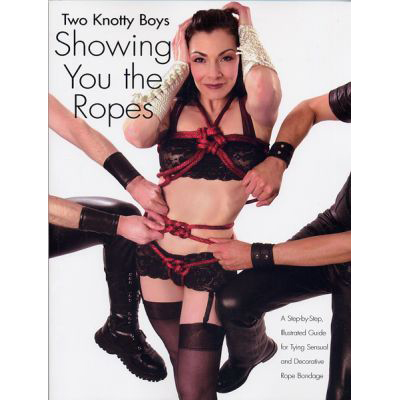
Review: Two Knotty Boys Showing You the Ropes

Despite absolutely loving rope bondage I really have only owned one bondage book before now, The Erotic Bondage Handbook, which isn’t exactly for beginners. It has great information within it, but assumes you know knots and ties already, unlike Two Knotty Boys Showing You the Ropes. Two Knotty Boys is a rope bondage instruction manual that is wonderful for beginners because it not only explains how to do different knots which you may or may not already know, and 37 different ties, but it also has pictures with captions detailing each knot and tie so that you can follow along easily.

I had absolutely no trouble in following the step-by-step instructions in Two Knotty Boys Showing You the Ropes. It is extremely helpful for the visual learner, since it’s easy to duplicate what you see in the images.

The book is separated into six basic sections: Introduction, The Knots, Basic Bondage, Decorative Bondage, Dominance Bondage, and Sex Bondage. The introduction gives you some basic ideas about rope bondage safety and different types of rope so that you are fully aware of the tools you need and how to be safe before engaging in the techniques described in the later sections.

The Knots goes over a number of basic knots and weaves as well as more complex ones like the trinity (celtic) knot. I thought I would have trouble with some of them, but most of them were easy to duplicate on the first or second try due to the picture guides.

Basic Bondage includes a few basic restraints, a rope spreader bar (they call “basic wrap”), rope shackle, anke wrap, a harness, and a gorgeous “dragonfly sleeve” which is kind of like rope armbinders (though prettier). They are all, pretty much, exactly as it says: basic. These are ties that don’t really require huge amounts of experience or talent to pull off, they are simple and easy to follow, as is evidenced by the basic wrap I put on Onyx (see picture). However, just because they are basic doesn’t mean they are not pretty on the eye or useful.
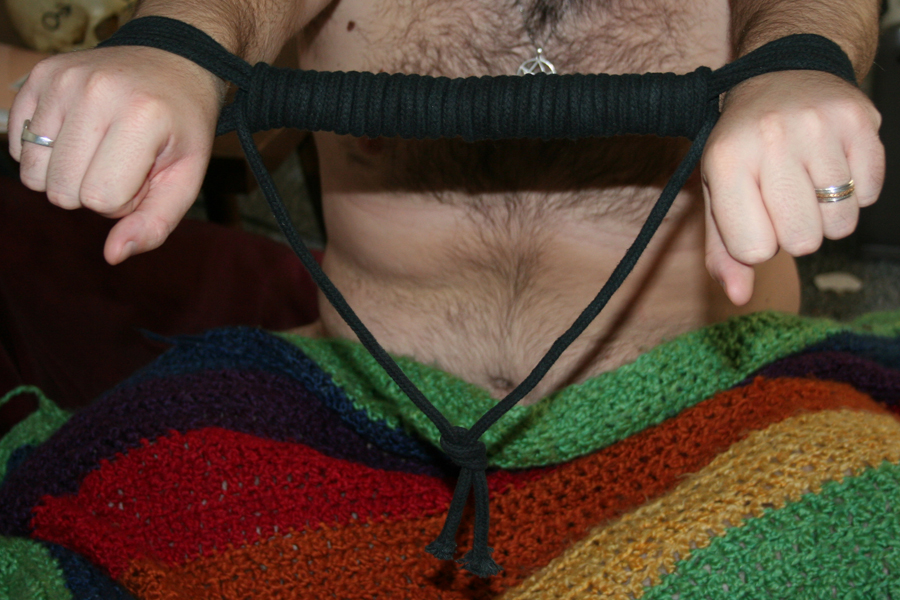
Basic Wrap - Rope Spreader Bar

Decorative Bondage is, well, filled with exactly that: bondage that is more for show than for functionality. It includes a corset, gauntlets (on the model on the front of the book), bra, panties, “good luck knot” harness (which is based around the “good luck knot” which is a five-sided knot–it is also on the model on the front of the book), and a bodysuit. Each compliments the wearer well, and while they are slightly more difficult than the basic bondage section they are also fairly easy once you get the knot techniques down. I made the panty which consists of a trinity knot (the celtic knot I mentioned earlier) and snake weave. It was very easy to make once I had the knot and weave down.

Dominance Bondage is more the type of bondage that we think of when wanting to tie someone up. It’s functional bondage that’s more intricate than the basic bondage but that can turn our willing victims into helpless slaves (or subs or bottoms as the case may be). It consists of three harnesses that don’t just decorate the body they also capture the wrists behind the back or neck, a hogtie, a bit gag, a bridle, and a “rope cage” which traps the body in a sort of rope bodysuit.

Sex Bondage is, well, exactly that. While there is a bit of overlap in Dominance Bondage and Sex Bondage, as much of Dominance Bondage could be used during sex, Sex Bondage focuses on affixing items to the rope wearer. It has a table top tie, two chair ties (kneeling facing the back of the chair, and sitting in the chair), and a rope strap-on harness. Each of these leave the wearer ready for sex, either open and unable to escape or with a new sex toy attached to fuck with.

All the ties are easy to do once you practice the knots a bit and with a willing and patient partner. I’ve only done a small amount of the ties that I hope and plan on doing, both on myself and on Onyx, but I feel more knowledgeable after reading through Two Knotty Boys Showing You the Ropes than I was before, and possibly ready to take on the first bondage book I bought after getting these basics down.

The best part about Two Knotty Boys Showing You the Ropes is that it is so accessible and easy beginners with little to no rope technique knowledge can pick it up and start rigging instantly. It makes fancy-looking ties and harnesses seem like a breeze to do. I would imagine it would be a great staple for intermediate or advanced riggers to have around the house as well, as it is much easier to follow than a text-only book.

With the holidays coming up, as well, it can make the perfect gift! You can get it for a loved one (or fuck buddy) as a hint that you would like to be tied up or tie them up. Or, if you know someone interested in rope bondage that hasn’t really given it a try it is the perfect book for them as well! As a gift or for yourself Two Knotty Boys Showing You the Ropes is a wonderful book with useful ties for all.

Assumptions

I wrote the following in response to Sinclair’s post defining identity alignment assumptions, basically “the assumption that one’s identity categories align with what is either a stereotype or a dominant compulsory cultural norm.” I ended up writing more than I thought I would, and I have more to add so I thought I’d just convert it into a post on here.

There are many identity alignment assumptions that I struggle with, including the assumption that I’m straight because I’m with a cis-man, the assumption that I’m straight because my primary gender identity is femme, the assumption that my gender expression is traditionally feminine instead of femme, and the assumption that I’m unhealthy or somehow immoral because I’m fat. I’m sure there are more, of course, if I started really thinking about them, but these are the biggest that have been impacting my life lately, especially the first.

I’ve always embraced my difference, and not being visibly different (even moreso recently since I dyed my hair a normal color) is difficult for me in general. I find myself having a difficult time embracing the queer community in general because even though I’ve never been straight and never will be straight I am perceived as straight by many, including many within the queer community. Most people want others to be monosexual, it seems, it’s easier to quantify people that way.

I know that I have some assumptions I make as well, though I’ve noticed that my assumptions are different depending on my location. In Utah I tend to assume most people are mormons and straight, but elsewhere I don’t actually think about what religion or spiritual affiliation people might have, and I tend to assume more people I come across are queer. I do often link gender and sexuality assumptions together, such as assuming masculine females and feminine males are queer, but I also tend to assume general queerness rather than gay/straight binary assumptions.

Occasionally I will try to spend a day purposefully assuming the world is the inverse of what society tells us, that queers are the majority (or total) population, that assumed gender expression doesn’t actually denote the sex of the person, that everyone is polyamorous, and that people won’t automatically judge me by my size. It’s a refreshing and sometimes humbling exercise, though it’s often shattered quite quickly.

[End of the comment: start of the extra]

I actively work on my own assumptions, but that doesn’t mean I don’t still have them, though it’s hard for me to pinpoint them. I try to not make the same assumptions about others that I feel others make about me, but I know I do it, like assuming straightness instead of queerness.

These assumptions extend beyond people as well, to places. I find myself making assumptions about Seattle and others make assumptions about Salt Lake City due to the identity associations there. I’ve had people mention being surprised that there is a kink community here, a queer community, pagan and occult communities. People assume that SLC is just a mormon hub that doesn’t have any kind of diversity within it, though they’ve obviously not seen SLC Punk. People are surprised when they find out I live in Salt Lake City, though I don’t wholly blame them because I’m surprised that I live here.

I’m finding myself making the opposite assumptions about Seattle. I know a fair amount about the city itself, and have been reading up on it even more since we decided to move there. I’m excited about the communities there. I assume that it is going to be easier for me to find people I click with there. I assume that because it is more liberal that I won’t feel as shut-in as I do here. I don’t know if these assumptions are in any way correct, however, because I’m not counting on that other factor: me.

Call for Submissions: Sexual Ability Anthology

Working Title: Sexual Ability: Embracing the Intersection of Sexuality and (dis)Ability
Editor: Shanna Katz, M.Ed, Human Sexuality Education, Widener University
Contact: sexualability@gmail.com
Submission Deadline: March 31, 2009

Even as we approach the end of the first decade of the 21st century, there is still a large gap in people’s minds when they think about sexuality as it relates to people who are disabled, whether cognitively or physically. While some studies have been performed regarding the potential for differently-abled people to lead satisfying sexual lives, in which satisfying seems to center around the ability to orgasm, very little has been written about the experiences involving the sexualities and experiences of people who identify as handicapped/disabled/differently-abled, as well as their partners.

People of all ability levels are sexual beings. Sex is hard enough to navigate and negotiate when one fits in with society’s notions of what a sexual being is, but once you add in the concept of ability, it can become quite challenge. This anthology, Sexual Ability, seeks to bring forward the stories, challenges and experiences of differently-abled people and their partners, putting a face on the trials that so many valuable members of our society must face. By sharing the experiences of the disabled community in relation to sexuality, Sexual Ability hopes to challenge people’s viewpoints, foster discussion and conversation, and open doors towards a shift in the social constructions surrounding sexuality and disability.

Essay submissions should be well thought out, and written in a scholarly manner. Acceptable submissions can be in the form of short research papers, non-fictional accounts of personal experience(s), discussions on issues regarding sexuality and disability, etc. Fictional pieces/erotica will NOT be considered. Each author may submit a total of two (2) essays for consideration.

Some topics that authors might consider (but are certainly not limited to) include;

  • Coming out to a new partner and facilitating the “disability discussion”
  • Reclaiming words surrounding sexuality and disability, such as “crip,” “handicapped,” etc.
  • Issues within the medical community; talking with doctors about being sexually active when you’re differently-abled.
  • Having to create new sex techniques, positions, conversations, or having to re-define the traditional definitions of sex, etc.
  • Disabled and queer, disabled and of color, disabled and religious; reconciling multiple identities alongside sexuality.
  • Re-conceiving your sexuality after loss of previous abilities, either solo or with a partner.
  • Ability and kink; negotiating within the BDSM community when differently-abled.
  • Sexuality and ability through out different cultural experiences.
  • Portrayal of disabled people in the media (film, TV, art, advertisements, etc) and the connection to sexuality.
  • Disability rights; the fight for them, and how they affect sexuality amongst the disabled community.
  • Birth control/contraception; getting it, using it, adapting it, as well as pregnancy/adoption/abortion.
  • Creating your identity as a disabled person who is a sexual being; how did it evolve, and what was your journey.
  • Any other subjects you feel cover the topic of sexuality and (dis)ability.

By March 31, 2009, please send:

  • Your 2,000 – 6,000 word submission, as a word document attachment. It should be titled as such: SubmissionTitleAuthorName.doc (example: SexualAbility.ShannaKatz.Doc). Submissions must be received in 12 point Times New Roman font and sent in via Word documents (other files and cut/pasted text will not be accepted).
  • Your complete contact information, including legal name, pen name (if you have one), phone number, email, address, and website (if you have one).
  • A 50-100 word biography about yourself.

Please submit the above to: sexualability@gmail.com with the subject line of “Sexual Ability – Submission.” Submissions will be read and reviewed as received, but decisions will be made final by July 2009. Please note that accepted submissions will be approved on a tentative basis, pending editorial board approval once the anthology has secured a publisher.

Questions can be directed to Shanna Katz at sexualability@gmail.com or please visit the Sexual Ability MySpace page at www. myspace. com/sexualability.

Please distribute widely. Feel free to post on blogs, websites, social networking sites, listserves, etc.

A note: I would not dare to define what disabled/handicapped/differently-abled meant to anyone. Please do not ask me if your disability counts; if you or your partner identify as such, then I welcome your submission to this anthology.

Powered by WordPress & Theme by Anders Norén